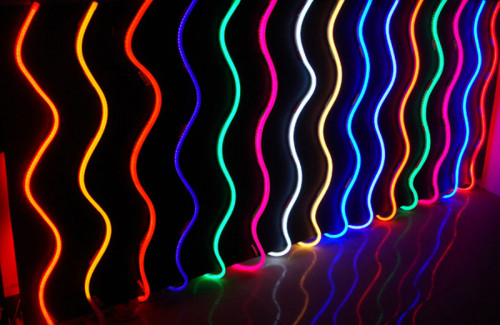
Currently, neon signs are a mandatory part of the design of the entrance group of shops and other institutions of various cities. The history of neon advertising repeats the development process of many inventions - initially, signs of this type were used only in wealthy areas of large cities. With the decrease in the cost of manufacturing technologies, the number of craftsmen for other customers became possible. Neon advertising partially decorates the facades of buildings in order to increase the recognition of a particular brand. Neon letters look especially impressive on the upper floors of high-rise buildings.
As early as 1675, the French astronomer Jean Picard noticed a glow in the mercury barometer tube, which is why it got its name – "barometric". At that time, no one thought about such a phenomenon as static electricity, so no one could explain the origin of the glow. Only in 1855, Heinrich Geisler (physicist and glassblower) created a tube that became the prototype for "steam lamps". Thanks to this, the history of neon signs went in the right direction. With the gradual electrification, the improvement of lamps began – transparent vessels were filled with das, and thanks to the voltage, the contents glowed.

When and where did the first neon sign appear?
To the question of when neon signs appeared, we can answer that similar designs arose thanks to William Ramsey and M.V. Travers. In 1898, in London, they discovered neon, which Georges Claude (a French engineer) firstly used. The design of 1902 can be considered the very first neon lamp, and in 1910 it was demonstrated to the public.
Another five years later, the device received its patent, thanks to which the company Claude Neon Lights, Inc. was born. Claude's colleague, Jean Fonsecchio, suggested using the designs for advertising purposes, on signs. Back in 1912, a sign was tested for a hair salon in Montmartre. Having dealt with the history of the origin of neon advertising, you can move on to how everything developed.
Later, signs of this type began to spread all over the world. So, in the 20s of the 20th century, a lot of advertising appeared, thanks to which neon designs became in demand. In the USA, they went further than anything else:
- signs were used almost everywhere - even in small shops;
- the constructions glowed during the day - they fascinated people who saw "liquid fire" so much;
- licenses for the production of signs began to be purchased for 100 thousand USD, so there were quite a lot of manufacturers - especially on the west and east coasts.
After the appearance of neon advertising, for some time the structures were called "Neon Claude" after the name of the engineer who created the technology. On the territory of Ukraine, occupied by the communists, it took a long time to master the technology of creating neon signs. They were only in big cities - at least they were used in cinemas ("Central", "Palace") and the park, and those were outside of Ukraine. When did neon signs appear in our country? Constructions began to be used more in the 60s of the last century. They were installed for thefollowing types of objects:
- large factories;
- department stores;
- entertainment centers;
- houses on the central streets of large cities.
In the latter case, it was especially important to emphasize the "wealth" of the USSR, so the largest cities were decorated with neon signs whenever possible, creating an attractive image for residents and guests. Until 1990, neon signs represented the absolute majority among similar designs. It got to the point that advertising was used even in small towns. Modern signs with neon appeared in the late 80s on the territory of Ukraine. In the 90s, similar designs gradually gained the attention of entrepreneurs due to ease of use, maintenance, brightness, and variety of forms.
The popularity of neon advertising these days
If earlier designers more often resorted to using more neutral colors or did not mix bright tones, now the production of a neon sign is carried out using violet blue and black colors at the same time. You can also see the "hard" combination of red and black. It looks impressive on a neon sign, especially since you won't have to look at the structure for a very long time.
Branded neon designs are flexible, that's why it is easy to achieve the desired effect envisioned by the designer. During the transition to energy-saving technologies, flexible neon is especially in demand due to the fact that it consumes 10 times less electricity. Considering the unusual origin of neon signs, one can come to the disappointing conclusion that the technology "survived" to the 20th century and today miraculously. It is constantly being developed and updated, which allows you to use signs almost everywhere - even in rural areas there are no problems with installation novadays. The main thing is the budget.